AS DEEP AS THE ATROCITIES?
Remorse over war still matter of debate
By JOSEPH COLEMAN
HANAOKA, Akita Pref. (AP) Townspeople cheered when the Chinese slave laborers, dressed in rags, eyes wild with hunger, were paraded back from the mountains after a failed rebellion and escape.
At the time, July 1945, many in this northern mining town thought the 800 slaves got what they deserved for killing several Japanese guards in their revolt: They were beaten, starved and tortured. At the end of the war, weeks later, just half were alive. The perpetrators got off lightly.
Three employees of Kajima Gumi, predecessor of today's construction giant Kajima Corp. that oversaw the workers, were sentenced to death and another to life imprisonment by the Allied war crimes court in 1948. But the penalties were later reduced, and all were released by 1955. The man responsible for laborers in the town is celebrated with a bust near where his charges were killed.
The "Hanaoka Incident" could easily enter the record as yet another example of how Japan, 60 years after the end of the war, has not convincingly faced up to the colossal slaughter of innocents as it conquered a wide swath of Asia in the 1930s and 1940s.
But there is another side to the Hanaoka story.
Yasuo Togashi was 9 when he and his neighbors cheered when the bone-thin escapees were recaptured. When he became an adult, he was overwhelmed with regret as he learned what those Chinese endured, and he joined a group of townspeople who dedicated their lives to keeping those memories alive.
"We thought the Chinese weren't even human, and we were happy when they were caught," said Togashi, 69, a retired teacher. "Now, I feel nothing but remorse. I didn't really understand it at the time, but as an adult I was really shocked about it."
Since the 1950s, Togashi and others have tried to set things right: They have built monuments, hosted survivors visiting from China, and taught schoolchildren about the past. The town holds an annual remembrance for the victims.
"We have to make an apology from the heart," Togashi said. "Even if they were not directly involved, people should feel regret about this. We have to make sure it never happens again."
Since the 1970s, Japanese prime ministers and even emperors have expressed varying degrees of regret and remorse over the wartime suffering caused by Japan.
In April, Prime Minister Junichiro Koizumi sought to defuse a surge of war-related tensions with China during a speech at an Asian-African summit. "In the past," he said, "Japan through its colonial rule and aggression caused tremendous damage and suffering for the people of many countries, particularly those of Asian nations."
Not all of Asia is clamoring for further atonement. Singapore, the Philippines, Indonesia and Vietnam, all conquered by the Japanese, have mostly come to terms with the war and are more interested in building ties with the world's second-largest economy than in dwelling on the past.
Yet, with the approach of Aug. 15, the day Japan marks as the end of World War II, it is clear many Asians have nagging doubts about the depth of Japanese remorse.
Those doubts can erupt into violence, particularly in areas that bore the brunt of Japanese expansionism. Anti-Japan riots broke out in China in April, triggered by the Japanese government's approval of a history textbook that critics say glosses over wartime atrocities.
The main reason for the doubt is the awesome scope of Japanese brutality as Tokyo built an empire that, at its height, stretched from deep in the Pacific to Southeast Asia.
The Japanese assault was merciless. Civilians were bombed, doused with biological agents, machinegunned and subjected to cruel medical experiments. Tens of thousands of women were forced into brothels for Japanese troops. Prisoners were tortured, executed, starved or worked to death.
Politics is another factor in the lingering resentment. The battle against Japanese aggression is a pillar in the communists' claim to leadership in China and North Korea.
But at the bottom, the Japanese themselves have not decided how much remorse they feel, and their ambivalence is reflected in ways that undermine their statements of regret.
On April 22, while Koizumi was apologizing for the war, at least one member of his Cabinet and more than 80 Diet members visited Yasukuni Shrine, which honors 14 Class-A war criminals along with Japan's war dead.
An increasingly powerful clique of revisionist scholars is encouraging a rollback of mentions of Japanese atrocities from wartime accounts in school textbooks.
Comic book artist Yoshinori Kobayashi has sold millions of copies of works that rant against the U.S. and Japan's neighbors and argue apologies for the war are humiliating.
Ground zero in Hiroshima, meanwhile, symbolizes a view of the war long engraved in Japanese hearts: that of Japan as victim.
Outside Hiroshima, there is the Holocaust Education Center to teach Japanese about Nazi atrocities. Its operators insist they make no connection between the Holocaust and Hiroshima, but the museum's location resonates deeply with the Japanese view of the bombings as a slaughter of innocents.
And nowhere does the museum note that Japan was Germany's ally, or that Japanese soldiers, like the Nazis, perpetrated mass killings and medical experiments on humans.
Kiyoko Nakano, visiting the Hiroshima dome, draws the standard Japanese lesson from the bombing of her hometown: that all killing of innocents is a crime and should be condemned.
But, unlike many Japanese, she includes her own country among the list of criminals and denounces those who seek to obscure Japan's wrongdoing.
The Japan Times: Aug. 4, 2005
Saturday, January 07, 2006
As Deep as the Atrocities? (article related to 'Revisionist Edutainment' below 1.5.06)
Posted by Christopher at 8:47 PM View Comments
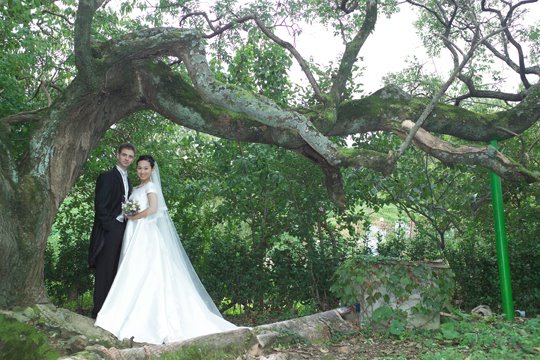
Wedding Photos

These photos were taken during the photo shoot that we did a couple of weeks before the wedding. We probably did about 30 different cuts, and went through at least 10 costume changes.
Wedding Photos
Posted by Christopher at 8:32 PM View Comments
Labels:
weddings
Revelation
I just looked back at some of the old posts on this blog. I'm not going to lie to you; I don't remember putting a lot of that stuff on there. But I guess I did.
It turns out that I've revealed a whole lot more about my life than I had originally intended to. I suppose that's OK...
It's just that I took most of last year off, and didn't really post much of anything on here. I guess that is part of what led to my current state of amnesia. The other part is simply that I'm not that smart.
Well it looks like I have a couple more hours before I need to go to bed. Maybe I'll post some more pictures.
Revelation
Posted by Christopher at 8:27 PM View Comments
Swallows Hire Furuta as Player-Manager!
The Swallows have hired their battle-hardened catcher, Atsuya Furuta, as 2006 player-manager of the team.
Furuta ended up grabbing this job a bit earlier than many had thought possible. Wakamatsu, the Swallows skipper of several seasons, bowed out at the end of the 2005 campaign. The top management of Yakult decided to pursue Furuta's services early due to the level of respect his teammates have for him, and the way that he has called the shots on the field for many years.
Furuta is perhaps best-known for spearheading the first ever player-led strike in Japanese baseball history toward the end of the 2004 season. He was able to organize all of the players behind a unified front, and together they won some impressive concessions from the owners association.
It was reported that Furuta wasn't going to take the job unless the Yakult front office decided to change some of its habits (ie. laziness). He was able to win promises of increased marketing for the ballclub, and the investment of more time, energy, and money in the recruitment of young players.
While many people are skeptical of the ability of a player-manager to lead a team to the Japan Series, few dispute the argument that Furuta will be able to lead the Swallows to a strong standing in the Central League during the 2006 season.
Swallows Hire Furuta as Player-Manager!
Posted by Christopher at 7:52 PM View Comments
Labels:
baseball,
Tokyo Swallows
Foundation Human Nature USA
I found a great non-profit organization that is doing wonderful things. With all the nonsense that is going on in the world, it's nice that some people are focusing their energy on helping the people who have been forgotten.
Foundation Human Nature USA (http://fhnusa.org/) has set out to try to help the small, overlooked communities in Ecuador and Ghana. They focus on health, environmental, education, and economic issues, and they have some very motivated volunteers working for them. I followed along in complete awe as a group of amazing people travelled to Ecuador to help erect a new clinic, and teach the local population about some of the health issues that they were facing. That last sentence doesn't even begin to explain all of the things that they did while they were there.
There are many of us who are very excited about this group of people, and what they are trying to do! I have been donating money to their cause online for over a year now, and I would encourage others to do the same. I usually donate with my debit card through a website called Network for Good (http://www.networkforgood.org/). I think they take 3% of the donation as a transaction fee, but it's worth it.
Network for Good has a large library of causes that are worthy of donations, and they make the process quite simple. You can easily look for a non-profit/volunteer organization that is doing things that matter to you, and then start giving whenever you're ready! As far as I'm concerned, the small group of inspired people at Foundation Human Nature USA (http://fhnusa.org/) deserve all the support they can get! Please join me in helping them reach more communities in the future.
Foundation Human Nature USA
Posted by Christopher at 7:34 PM View Comments
Labels:
websites
Babysitting 6
We've been on a steady diet of Magic English over the past several months. Disney has created a series of EFL DVD's that uses clips from theie extensive library of animated films. These DVD's are 30 minutes in length, and primarily targeted at children. However, I imagine that just about anyone who enjoys Disney's films will find these DVD's an entertaining alternative to studying the latest TOEIC manual.
Miyu and I watch one of the DVD's almost every day. There are a few of them that she particularly enjoys, so we've watched them a whole bunch of times. I like the Magic English series because each DVD includes plenty of speaking practice, and a theme that is backed up by a custom-made song (involving the target language for each specific DVD). Some of the songs are semi-catchy (from my point of view), and very easy for Miyu to remember.
The Magic English series has helped to get Miyu talking a little bit more. However, we're still dealing with some pretty big obstacles. The lessons are still taking place in a Japanese-first environment, and that has been a problem that we haven't found a way to avoid.
Another problem is that Miyu is incredibly shy and dainty. She loves to play, and pretend she's a princess, but she doesn't always want people to be focusing on her. Many times she'll muff her pronunciation of short English phrases on purpose so as to deflect attention from herself.
However, she also has an increasing tendency to come up with startlingly clean, simple English at times. I don't know why, but it's usually when her grandmother isn't in the room. It usually happens when she's forgotten to be guarded about what's going on, or when she's mentally engaged in something else. Sometimes it just pops out! I don't make a big deal out of it so as not to embarrass or patronize her.
Miyu will be starting Kindergarten this spring. That will likely mean a schedule change for us; maybe no more morning lessons. I'm worried about how much energy she will have at the end of the day after she comes home from school.
Babysitting 6
Posted by Christopher at 2:35 PM View Comments
Labels:
babysitting
Beware of Reunion.com!
I spent about 15 minutes trying to track down the name of an old friend from when I lived in Spain. I was easily able to find his address and phone number, but no email address. Didn't hotmail used to have a service where they would let you mail other hotmail members through a search function? They would allow you to send an email, but they didn't allow you to see the person's email address until that person decided to write back to you. I can't find that service now--just the MSN white pages...
Anyway, I clicked on a link that said it would help me find my friend's email address. That link directed me to reunion.com. In bright red letters reunion.com informed me that they would reveal all of their information on my friend if I registered as a non-paying member of their site. Harmless enough, right? Well, on the very next page they informed me that my registration went through successfully, but that, alas, they had no information on my friend. In my book, they lied to me.
So, to quickly rescue my email address from additional spam, I raced to my inbox, and found my confirmation email. Instead of confirming my account, I went back to their website and asked them to delete my account. I might add that it isn't nearly as straightforward as it should be to delete one's account. At least not as easy as it is to delete your blog on blogger.com.
After going through the necessary motions to delete my account, I received this email from reunion.com:
We received your request to be removed from the Reunion.com database. This is assigned Help Request number..............................
The account associated with email address {mailto:{blahblahblah}@hotmail.com is now queued for deletion.
Please allow 10 business days for processing of the removal request. (bold lettering mine)
If you have billing or other issues please go to http://help.reunion.com/selfhelp/
and create a separate ticket with the appropriate category.
Regards;
Customer ServiceReunion.com, Inc.
I'm pissed that they plan to take 10 days to delete an account that took me less than 10 seconds to create! Let me see, how many organizations can you sell someone's email address to in 10 days?
I wonder how many other people have been lied to by reunion.com.
Beware of Reunion.com!
Posted by Christopher at 1:40 AM View Comments
Thursday, January 05, 2006
Revisionist Edutainment: Japanese Comic Books
Unfortunately, a kid from the university where I teach is being quoted extensively on the popularity of the new revisionist textbooks. Oh, did I say 'textbooks'? My bad, I meant 'comic books'.
The quote that has leapt out at me a few times is from when he said something to the effect of, 'Each country has the right to interpret history in any way it sees fit.' Right. We'd be so much better off if post-war Germany had swept all of its atrocities under the carpet like Japan has. Oh yes, it's true; all those folks that caution us to learn from the past so that history doesn't repeat itself? They're full of crap.
This new breed of comic book sets out to paint a rosier picture of Japan's colonization of other countries in Northeast Asia during the first half of the 20th century. One comic book that I've looked through frames Japan's colonization of Korea in the modern day context of the 2002 Soccer World Cup. The subtitle of the book, loosely translated, is 'How South Korea Cheated and Ended Up in the Semifinals'.
Saying that these comic books paint a 'rosier' picture of Japan's colonist past implies that Japanese school children are being taught all about how their country's attempt to expand its influence over this region resulted in several large-scale atrocities. However, that is not the case.
History education usually stops short of the modern era, and the circumstances surrounding the horrific nuclear bombings of Hiroshima and Nagasaki at the hands of the United States are 'briefly' touched upon at best. The English language textbooks (all students are required to study English) used in the secondary education system here actually head back the other way. The message to be gleaned from the stories contained therein is that Japan was the victim. Hey, that's not propaganda the students are being fed in class, is it?
Comic books are a way of life over here as far as entertainment goes. You don't need to crane your neck very far to catch people of all ages reading them on their train-ride home after work/school. These 'rosy' comics are finding a receptive audience, and more are in the process of being published. It seems that some people are happy to have some kind of retort to all of the condemnations that are aired by both North and South Korea and China on the nightly news. The media never bothers to put the protests in context, so few people have a firm grasp of what's going on. At least now, because they read the comic book, they can say, "Oh, and this is the thanks we get for paving their roads, reorganizing their mess of a market at 'Namdaemun', and not raising a stink over the fact that we think they made the red dot on our national flag too big at the opening ceremony of the world cup in 2002!"
Try reading through Trans-Pacific Radio's article on what happened in Nanjing, or Google 'Comfort Women', and you'll probably have a better understanding of the historical context of the situation than the majority of people that went through Japan's public education system. What makes things more difficult is that the old guard in the government, including politicians who enjoy wide popular support (like Shintaro Ishihara, mayor of Tokyo), have said on the record that many of those atrocities never happened.
Anyone in the US government who tries to say that atrocities were not committed at the hands of our own soldiers will be slapped silly by the press, disowned by their political party, and most likely not re-elected the next time around. The opposite is true in Japan. The end of Iris Chang's book, The Rape of Nanking, quickly details some of the things that have happened (harassment and murder, just to name a couple) to those academics and politicians who dared to challenge the prevailing denial that continues to exist in modern-day Japan.
Part of the blame for all of this, of course, falls on the United States. Why was Hirohito let off the hook? According to John W. Dower in his Pulitzer prize winning book 'Embracing Defeat', the American occupiers were fearful of a popular revolt if Hirohito, who was revered like a god, were held accountable for what went on during his rule. The Tokyo war crimes trials (ie. victor's justice) ensued, and Dower argues that the denial is partly rooted in the conservative wing's resistance to accepting the way that guilt was established after the war.
We're currently seeing more carefully orchestrated trials being conducted where Milosevic and Hussein are concerned. Someone actually took the time to learn something from the mistakes of the past! Imagine that. Are these modern trials still just a more clean-cut form of victor's justice? That's definitely arguable.
So what the hell does all this mean?
Well, it means that a surprisingly large portion of the metropolitan population is getting it's historical analysis from a comic book that admittedly tilts history in an inaccurate way.
Lots of laughter and common-sense objections arise from this, at least from an onlooker's point of view. This is similar to how the Catholic and Protestant churches, during the 16th and 17th centuries, tried to bend history in their respective favor. Both were determined to prove that, historically-speaking, their church went back further, thus staking a stronger claim to the idea that they were the one true interpretation of Christ's life and death.
OK, maybe that wasn't the best comparison I could have drawn here, but hopefully the stupidity of both approaches to interpreting history is evident. Many would argue that both sides of the story need to be told in order to keep history from repeating itself, and those people would sound exactly like my parents. Of course, we Americans are very fortunate because we have cable networks like FOX news to give us exceedingly balanced accounts of what is going on in the world around us...
Now admittedly, the perils of a revisionist set of comic books aren't all that nasty. Indignation is sure to spout out from all sorts of angry orifices, but we're not looking at an impending remilitarization of Japan or anything (oh wait...). A disgruntled netizen in a chat room in South Korea wrote, 'Well fine. I'm just going to start producing comic books that embellish the atrocities they committed, and makes Japan look like even more of a bad guy than it already is!' Luckily, the other people in the chat room were a bit more on the adult-side of the maturity spectrum. They quickly told him to shut the hell up.
"What, so stooping to their level is going to get them to stop?!?" one person wrote.
I would argue that the bigger challenge is going to come from China. The government over there still has a pretty impressive control over what news the average person sees and hears. Beijing is also quite good at fanning public resentment--one of its favored ways of flexing its muscles with regard to countries is doesn't like. More importantly, China is a country of one billion-plus people--one billion-plus people who tend to have a negative opinion of Japan--and it is going to be an increasingly difficult opponent, economically-speaking. This is just my opinion, but it seems that purposefully antagonizing a giant (that is only getting bigger!) is clearly bad policy.
On a positive note: these new revisionist textbooks (damn, did it again), are bringing people closer to a real dialogue about what went on during Japan's colonization of this region. The few people I have spoken to about these comic books are aware of the factual inaccuracies, so this could lead to a discussion of what actually went on. Maybe, but then we still have to do something about those revisionist history comic books, er, I mean textbooks that they use in the junior and senior high schools.
PS. Dower's 'Embracing Defeat' is fantastic. I highly recommend it. Chang's 'The Rape of Nanking' will probably make your stomach hurt, but qualifies as interesting reading.
Revisionist Edutainment: Japanese Comic Books
Posted by Christopher at 9:13 PM View Comments